Houston, We Have a Market Cycle: Reading Crypto's Ups and Downs Through a Cosmic Lens
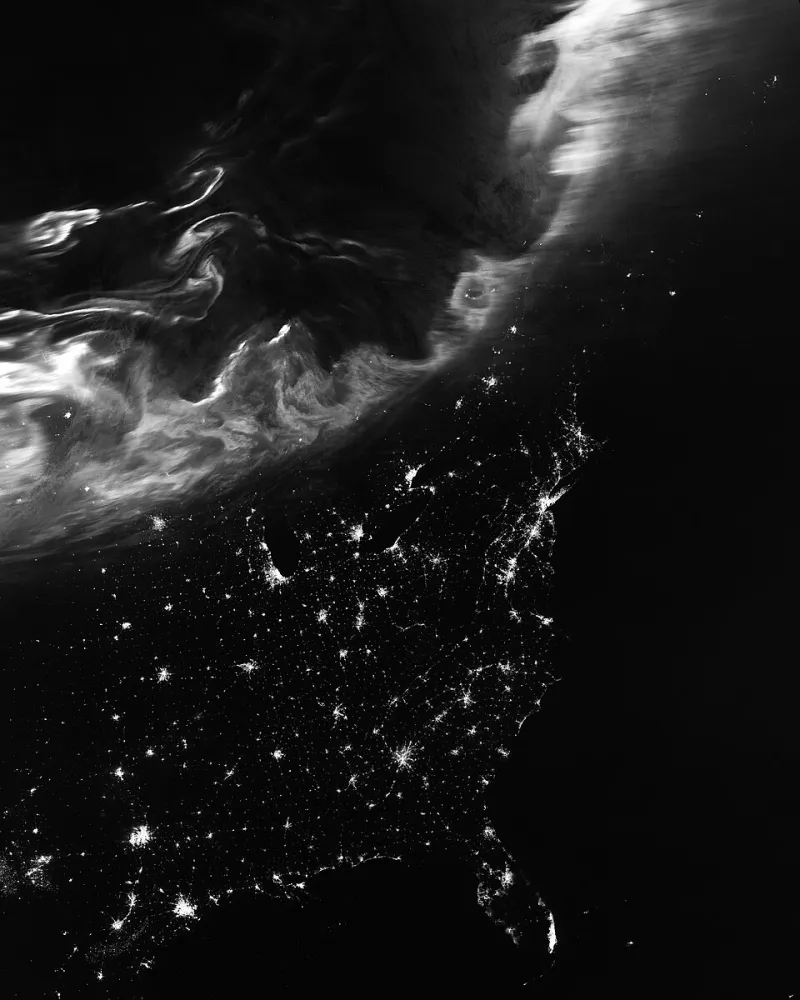
Photo: NASA Earth Observatory image by Michala Garrison, using VIIRS day-night band data from NASA EOSDIS LANCE, GIBS/Worldview, and the Joint Polar Satellite System (JPSS). Story by Emily Cassidy., Public domain, via Wikimedia Commons
Opinion | UranusCoin Editorial
Let's be real for a second. If you're newer to crypto and you've been trying to understand market cycles by reading traditional financial analysis, you've probably ended up more confused than when you started. Phrases like "macro headwinds," "liquidity contraction," and "risk-off sentiment" don't exactly make the learning curve gentler.
So we're trying something different. Here at UranusCoin — where we've always believed the cosmos has something to teach us about the markets — we're going full astronomical metaphor. Because here's the thing: the universe has been running dramatic, predictable, occasionally terrifying cycles for about 13.8 billion years. Crypto's been at it for maybe 15. The cosmos has notes.
This isn't financial advice. It's a cosmic orientation guide. Let's launch.
🌞 Bull Runs Are Solar Flares — Brilliant, Powerful, and Not Forever
If you lived through late 2020 into 2021, you know exactly what a crypto bull run feels like. Prices climb, then climb faster, then seem to go vertical. Your portfolio balance looks like it was designed by someone who doesn't understand the concept of limits. New tokens appear daily, each one promising to revolutionize something. Your coworker who's never mentioned investing before starts asking you about NFTs.
That's a solar flare. Massive, dazzling, and packed with energy. Solar flares are real events — genuine releases of electromagnetic power from the sun — but they're also temporary. They peak, they subside, and the sun goes back to its baseline.
Bull markets work the same way. The energy is real. The gains are real. But the peak is always, eventually, followed by a return to something closer to equilibrium. The mistake a lot of newer investors make is assuming the flare is the sun — that the explosive growth phase is the normal state of things. It isn't. It's a cycle within a larger cycle.
What this means for you: During bull runs, take some profits. Seriously. Nobody's ever gone broke locking in gains. You don't have to exit everything, but don't let euphoria convince you that this particular flare will never end.
🪐 Bear Markets Are Planetary Retrograde — Disorienting, But Not Actually Backward
When Mercury goes retrograde, astrology enthusiasts brace for chaos. Communications break down, travel plans go sideways, and everything feels slightly off-kilter. Here's the astronomical truth though: Mercury isn't actually moving backward. It just appears that way from Earth due to the relative positions and speeds of the two planets.
Crypto bear markets have the same vibe. When prices are falling for months on end — and 2022 was a brutal example of this — it can genuinely feel like the entire project of decentralized finance is moving in reverse. Projects fail. Portfolios shrink. Confidence craters. The headlines get grim.
But the underlying technology doesn't stop developing during a bear market. Builders keep building. Protocol upgrades ship. New infrastructure gets laid. The ecosystem isn't going backward — it just looks that way from where most people are standing, because price is the only metric most people are watching.
Historically, some of the most important development work in crypto's history has happened during bear markets, precisely because the speculative noise dies down and the people who are genuinely committed to the technology get to work without distraction.
What this means for you: Bear markets are brutal emotionally. They're also when the real opportunities tend to show up, if you can stomach the uncertainty. Research projects you believe in. Watch developer activity. And remember — retrograde ends.
☄️ Altcoin Season Is a Meteor Shower — Spectacular and Surprisingly Predictable
Every so often, the crypto sky lights up with a shower of altcoin gains that can make Bitcoin's performance look sleepy by comparison. Coins that have been sitting quietly for months suddenly 3x, 5x, 10x in a matter of weeks. Social media goes wild. New projects get hot overnight.
This is altcoin season, and like a meteor shower, it tends to follow a pattern. Meteor showers happen when Earth passes through debris left by a comet — it's predictable enough that astronomers can tell you roughly when to look up. Altcoin seasons similarly tend to follow Bitcoin's big moves: BTC runs first, then Ethereum, then capital rotates outward into smaller-cap alts as investors chase higher returns.
Knowing the pattern doesn't mean you can time it perfectly. But understanding that altcoin seasons are cyclical — not random — helps you stay prepared rather than perpetually surprised.
What this means for you: Don't chase the shower once it's already blazing overhead. The best positions in altcoin season are usually built during the quiet periods before it starts. Do your research during the boring stretches so you're ready when the sky lights up.
🛸 HODLing Is Orbital Mechanics — Trust the Trajectory, Not the Turbulence
Orbital mechanics is the science of how objects move through space under the influence of gravity. Here's what's wild about it: once you're in a stable orbit, you don't need to constantly fire your engines to stay on course. The physics takes care of it. The path is set. Short-term disturbances — a bit of atmospheric drag, a small gravitational tug from a passing body — don't knock you out of orbit.
Long-term HODLing works on a similar principle. If you've done your research and you genuinely believe in the long-term value proposition of a project or asset, short-term price volatility is essentially just turbulence in the orbital path. It's real, it's uncomfortable, but it doesn't necessarily change the destination.
The investors who've done the best in crypto over multi-year time horizons are mostly people who identified projects they believed in, accumulated positions, and didn't panic-sell every time the market got bumpy. That's not passive — that's a deliberate strategy based on conviction.
What this means for you: HODLing isn't just stubbornness. It's a choice to trust your long-term thesis over short-term noise. But it only works if you've actually done the research to have a thesis worth trusting. Blind HODLing is just hoping. Informed HODLing is strategy.
🔭 New Tokens Are Newly Discovered Moons — Intriguing, But Verify Before You Land
Astronomers discover new moons in our solar system with surprising regularity. Saturn alone has over 140 confirmed moons, many of them discovered in the last decade. Each new discovery is genuinely exciting — a previously unknown object, a new piece of the solar system's puzzle.
New crypto tokens launch constantly in the same spirit. Some of them are genuinely innovative — solving real problems, building real communities, creating real value. Others are essentially space debris: not dangerous on their own, but not worth landing on either.
The discovery is exciting. The due diligence is what keeps you from landing on a rock that turns out to be mostly empty.
What this means for you: New token launches deserve curiosity, not immediate conviction. Look at the team, the tokenomics, the use case, and the community before you commit capital. The outer reaches of crypto are full of fascinating objects — some of them are worth visiting, and some of them will just leave you stranded.
Final Transmission
Crypto markets are genuinely complex, and anyone who tells you they've got the whole thing figured out is either lying or selling something. But the patterns are real, the cycles are identifiable, and understanding the rhythm of the market — even imperfectly — puts you in a much better position than flying blind.
Out here at UranusCoin, we think the cosmos has always been the best teacher. Cycles, orbits, flares, showers — the universe doesn't promise smooth sailing, but it does promise that everything moves, everything changes, and everything comes back around eventually.
Stay curious. Stay patient. And keep exploring the outer reaches.